
While reading through this week’s articles and watching Chimamanda Adichie’s TEDtalk there was one word constantly popping up in my head burdened. Alice Walker, Audre Lorde, Barbara Smith, Anzaldua, Barbara Christian, and Chimamanda Adichie, all focus on the burdens and struggles that come with being a Black woman and a Black woman who is an artist.
In Alice Walker’s In Search of Our Mother’s Garden, she focuses on the burdens that black women face daily because they are forced to carry the weight of the issues that no one else wants to face, “Black women are called, “the mule of the world.” Because they have been handed the burdens that everyone else refused to carry.” What resonated with me while reading Alice Walker’s article is how black women automatically lose even more respect and receive lower status just by being a black woman and being an artist. It angers me so much. Another line that I felt stuck with me from Alice’s article was, “What did it mean for a black woman to be an artist in our grandmother’s time? It is a question with an answer cruel enough to stop the blood.” This line stuck with me because it shows the dangers and the burdens that black women face by being a black woman and being a writer.
In Chimamanda Adichie’s TEDtalk, “The dangers of a single story,” she focuses on a similar idea of burden that Alice Walker talks about in her piece. I felt myself needing to watch this TEDtalk again just because of how shocked and angered I felt by everything Chimamanda talked about. In this TEDtalk, Chimamanda focuses on how we can develop a “single story” of someone based off the limited prior knowledge we may have. Chimamanda explained that a single story is showing people as one thing, as only one thing over and over again, until that is what they become. Chimamanda tells the story of a poor boy named Fide, who was the new house boy for her family. Through visiting Fide’s village and seeing where he came from, for the first time Chimamanda realized she had a single story about someone. Chimamanda had assumed that because Fide came from a poor family that no one from that family could create something as beautiful as the basket Fide’s brother had made.
“It had not occurred to me that anybody in his family could actually make something. All I heard about them was how poor they were, so that it had become impossible for me to see them as anything else but poor. Their poverty was my single story of them,” this was the one line that really stuck out to me and stayed with me throughout watching this entire video. This line made me think of how many times in my life I have caught myself or someone else creating a single story or being biased about someone or something. The next story Chimamanda told was about her first roommate in college. Her roommate assumed that because she was from Nigeria, Chimamanda only listened to tribal music and didn’t understand how to use a stove. This story reminded me of a story one of my friends recently told be about a single story someone had about her based on the hometown she is from. This friend and I both come from the same very small hometown in upstate New York that no one knows about unless they have vacationed here. My friend was sitting in her first day of French class this semester while her professor was asking people to share where they have lived throughout their life. My friend shared that she had only lived in one place her entire life besides being born in the hospital. Her professor was shocked, not because she had only lived in one place her entire like, but because her small hometown he had never heard of surprisingly had a hospital. A couple days later this same professor was sharing a French history lesson with his students. He stumbled upon a horse and buggy and he made a comment to my friend that this was the only mode of transportation she must have in her small town. I know that this situation between my friend and her professor was all a joke, but it still made me think of how we can judge someone or have a single story of someone based on where they came from.
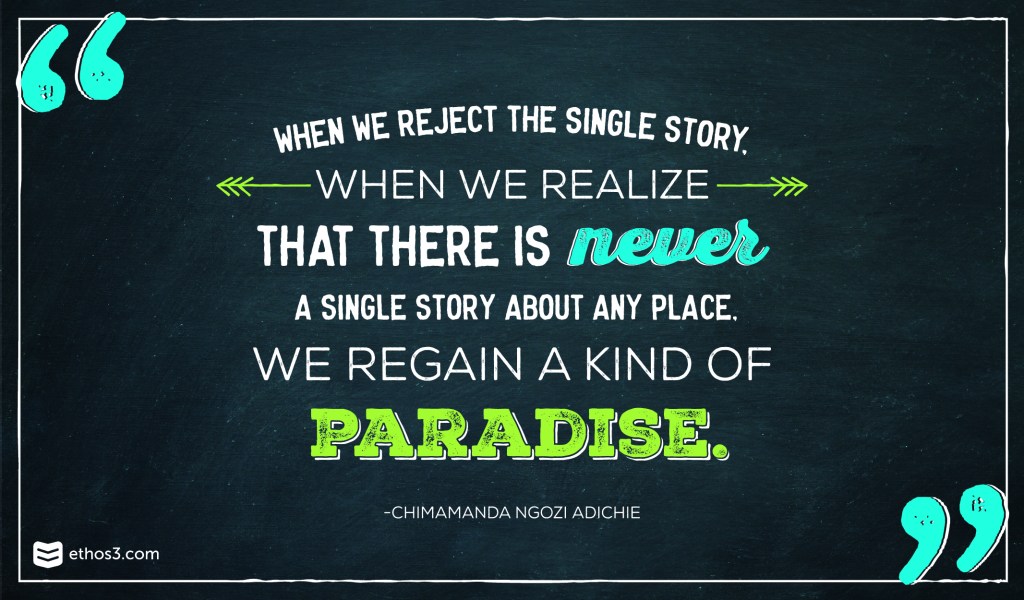
Throughout Chimamanda’s entire TEDtalk she focuses on how dangerous it can be to have a single story of someone. A single story can rob people of their dignity, it can create stereotypes, and it makes us different. Having a single story about someone makes that story the only story about them, which can create a biased view of a person. While watching this TEDtalk I noticed myself thinking back to Alice Walker’s piece, “In Search of Our Mother’s Garden,” and how in this piece she talks about the struggle black women writers face being a woman and being an artist. This made me think of how black women of the past and today have a single story written about them. This single story written about black women writers has kept these women from using their creativity for years. Chimamanda ends her TEDtalk with the positives of have many stories, rather than having just one story, “That when we reject the single story, when we realize that there is never a single story about any place, we regain a kind of paradise.” The ending to Chimamanda’s TEDtalk in a way reminded me of the ending to Alice Walker’s piece, “Guided by my heritage of a love of beauty and respect for strength—in search of my mother’s garden, I found my own.” This reminded me of the ending to the video because it was through looking at others stories and through looking at the creativity of others, that Alice Walker was able to find her own creativity and passion for writing.
Response question: What do you think is the single story that is written about black women as writers?
Response question: Has there ever been a time you felt that you had a single story of someone? Have you ever caught yourself being biased towards someone or something? You don’t have to share if you don’t feel comfortable!

Hi Jess!
I enjoyed reading your blog post and I love that you chose to focus your blog on Chimamanda Adichie’s TEDtalk, “The dangers of a single story”. I have deeply analyzed her talk in my previous two classes with Professor Savonick, however, each time I find myself noticing a particular part of the talk that I didn’t quite pay attention to before. This time as I re-read the transcript, I found myself stuck on one particular quote: “Like our economic and political worlds, stories too are defined by the principle of nkali: How they are told, who tells them, when they’re told, how many stories are told, are really dependent on power”. This quote got me thinking about what stories make it to the media and how the media portrays those single stories to us. I often used to find myself making small judgements towards a race, religion, or culture simply based off a media coverage. Overtime, I have learned the importance of knowing that people have multiple, complex stories.
This brings me to your second question on your blog. I have caught myself being biased towards something and actually this bias acquired to me recently. During the pandemic, people who did not have their jobs were able to apply for unemployment. A friend of mine who was working at a part-time fast food restaurant went on unemployment because she found that unemployment was a perfect opportunity for her to do nothing and still make a lot of money. Later, I found out that she was making a lot more money than she ever would have been even if she was working. Further, my boyfriend who is a plumber and an essential worker, works 5am-7pm on most days and usually doesn’t have his weekends off. While my boyfriend was making less than my friend but working so much harder, I found myself becoming angry with the situation and I began to have one single perspective on unemployment and the type of people who got it. I was so annoyed with my friend that I began to dislike unemployment completely. A couple weeks after this incident, my best friends mom who is a single mother to five kids, got fired from her job and had to file for unemployment so she could take care of her kids. Once, my best friend told me her situation, I realized that unemployment was vital for her family to survive through the pandemic which changed my entire single perspective on unemployment.
Hey Jess,
Your first question made me think long and hard about what I have read that had been written by a black woman. As intriguing as this was for me, it also made me think a lot about how we talk about these women and their works. Often words like “recovered”, “reclaimed”, and “resurgence” are some of the euphemisms that jump to the forefront of my thoughts. Having read a healthy amount of academic writing around black authors in the late 19th and early 20th century, it was always troubling to hear that there was a “resurgence” of writers of color, which to me was ironic seeing as there wasn’t ever a point in time where those written works and authors flourished. I believe that this is one of those single story narratives that is perpetuated in schools today, that the stories of black women were simply “lost to time” and that good fortune and luck alone allowed a white academic to stumble upon them decades later as a “find”. They were never even given a chance. Only then are they discussed in schools. This has never sat well with me, don’t get me wrong, these readings were challenging for me being that I am the polar opposite of the author, and almost certainly not the intended audience. But both of those things made for a more self-critical lens while reading things like Home, Their Eyes Were Watching God, and Quicksand. It pushed me to interrogate assumptions and seek out implicit bias in my own analysis. I’m forever grateful for having the opportunity to read these novels, but with Adichie’s TED Talk in mind, it saddens me that it takes the attention of a white institution to un-oppress these writings. I worry that this action of “freeing” these authors ingrains some sense of ownness to those who “found” them, when the reality of the situation, and the very contents of the book scream in opposition to such an action.
To your second question, I have in the past, especially when I was in high school. For some unfortunate reason, high school was a period of time where we all just accepted the first thing we heard about anyone. I feel that this is a little more complex now, especially since we’re seeing more sides of everyone through social media because of the pandemic. And you get these little personality updates so frequently, it makes it almost impossible to pin a single story down. I guess this is a potential upside to the pandemic?
Jess,
I love that you opened up your blog post with that picture, and I appreciated how you kept your post tied together around your central ideas (I think I could have done that a little more in my post). I also appreciated that you discussed the TEDTalk and Alice Walker’s piece, because they both stuck out to me too. Both pieces really made me think about some ideas and concepts that I had not thought much about before – like about how there must have been so many creative and artistic black women in the past who never got a chance to share their brilliance with the world as a result of being oppressed, and how black woman who do get to share some of their creative and artistic abilities with the world today are doing so partly in the form of those who came before them, but never got to share.
In response to your first question, I think that often times the single story that follows black women as writers is that these women are vindictive. I think, for instance, that there are a number of white people out there who do not give their ears to black female voices because they feel like those voices are scolding them, holding them accountable for something they might not have done, or changing their lives in a way that is not “convenient.” I wonder if this boils down to the historic power and lack of oppression that white people have had, and that maybe this single story some have created for black women writers is a result of white people historically not being used to minorities around them speaking up. Perhaps that is too simple of a way to look at it, but I do find it very unfortunate and frustrating when black female writers get written off as angry or vindictive.
In response to your second question, I most certainly have caught myself having a single story of someone or something in my life before. I think having a “single story” of something or someone can come in a variety of ways, and varying degrees of seriousness. For example, I have had a single story about One Direction in the past, in that I thought they were just a corny boy band that made music only for teenage girls to listen to. I must admit, I was wrong in that case, because I have found myself jamming out to some One Direction songs over the years, and I find all of the members to be quite talented and interesting. That is not the most serious example of having a single story of something, obviously, but I have caught myself having more serious single stories as well. When I was in sixth grade, I had a very good friend who was black. He was very silly (for lack of a better word), spoke quite well, and in some ways was quite like me. I remember thinking to myself, and unfortunately telling him, that he did not act like a black person, because I had a single story for black people in my mind — that they did not speak very “well” and acted and spoke quite differently from me. I, of course, do not have this single story in my mind now, and I hope those of you reading this do not hold my sixth grade foolishness against me.
Hi Jess,
I enjoyed reading your post. It reminded me of how powerful a narrative can be, and it made me think about how narratives are probably what create biases in our culture, in so many different cases. There is simply power in story. It made me think of our current crisis and the Black Lives Matter protests. While the protestors who are peaceful are certainly numerous, the dominant narrative is the violent ones because they receive more media attention. Therefore the dominant narrative is damaging for peaceful protestors. Chimamanda Adichie truly has experienced the dominant narrative bias first hand. What truly captivated me about her talk was that she mentioned the literature that she had the opportunity to read was always extremely different from what her life narrative was; she never read about characters that she could relate to, and that turned into her literacy experience. She believed she’d have to write based on narratives that he couldn’t relate to, because that was the only literature she had consumed. Personally, as a girl who was also attempting to write little chapter books when I was 7 and 8, this was something that I could not relate to. I always tried to make my characters like me and my friends, but I was also reading literature that had to do with people that “looked” like me physically. In her reading, she experienced the dominant American narrative story- the white girl with blue eyes who ate apples and played in the snow… She experienced literature as something she was enstranged to because of the characters she had read about. It frustrated me greatly that she believed her love for literature would have to be expressed through someone else’s narratives.
There truly was a time in my life where I had a dominant narrative for someone. When I was younger, my parents sponsored a girl in Mexico through a company called Compassion. I remember when we were looking through the images of children who needed sponsors (I was about 7) all of the children looked sad. However, I know for a fact that there was no way every single child who had their picture taken was truly sad- I now believe the photographers told the kids not to smile when they took pictures of them, in hopes they would get more sponsors out of pity. Compassion tried to create this narrative that the kids were poor and helpless. Although their situations were not ideal and the levels of poverty varied, their narrative never matched up with the girl I sponsored. As I wrote to her, she would send me photos of her going to school. Her school looked similar to those in the US, and her outfits looked really cute. “Her house probably has a dirt floor,” my parents would say. They said it not to be condescending, but to help me “understand” what she was going through. Within the last year I was able to travel to Mexico to meet her. While her situation wasn’t glamorous, her life was definitely normal, and she was comfortable in her home; it looked like mine, but maybe a bit smaller. I think that the desperation narrative that my parents told me about came largely from the sponsor company, and it is one they give many sponsors. As a kid, I wasn’t as influenced by this narrative as my parents were, but I always wondered why her letters and pictures never line up with my parent’s and the company’s interpretation of her life were.