While reading through this week’s articles and watching Chimamanda Adichie’s TEDtalk there was one word constantly popping up in my head burdened. Alice Walker, Audre Lorde, Barbara Smith, Anzaldua, Barbara Christian, and Chimamanda Adichie, all focus on the burdens and struggles that come with being a Black woman and a Black woman who is an artist.
In Alice Walker’s In Search of Our Mother’s Garden, she focuses on the burdens that black women face daily because they are forced to carry the weight of the issues that no one else wants to face, “Black women are called, “the mule of the world.” Because they have been handed the burdens that everyone else refused to carry.” What resonated with me while reading Alice Walker’s article is how black women automatically lose even more respect and receive lower status just by being a black woman and being an artist. It angers me so much. Another line that I felt stuck with me from Alice’s article was, “What did it mean for a black woman to be an artist in our grandmother’s time? It is a question with an answer cruel enough to stop the blood.” This line stuck with me because it shows the dangers and the burdens that black women face by being a black woman and being a writer.
In Chimamanda Adichie’s TEDtalk, “The dangers of a single story,” she focuses on a similar idea of burden that Alice Walker talks about in her piece. I felt myself needing to watch this TEDtalk again just because of how shocked and angered I felt by everything Chimamanda talked about. In this TEDtalk, Chimamanda focuses on how we can develop a “single story” of someone based off the limited prior knowledge we may have. Chimamanda explained that a single story is showing people as one thing, as only one thing over and over again, until that is what they become. Chimamanda tells the story of a poor boy named Fide, who was the new house boy for her family. Through visiting Fide’s village and seeing where he came from, for the first time Chimamanda realized she had a single story about someone. Chimamanda had assumed that because Fide came from a poor family that no one from that family could create something as beautiful as the basket Fide’s brother had made.
“It had not occurred to me that anybody in his family could actually make something. All I heard about them was how poor they were, so that it had become impossible for me to see them as anything else but poor. Their poverty was my single story of them,” this was the one line that really stuck out to me and stayed with me throughout watching this entire video. This line made me think of how many times in my life I have caught myself or someone else creating a single story or being biased about someone or something. The next story Chimamanda told was about her first roommate in college. Her roommate assumed that because she was from Nigeria, Chimamanda only listened to tribal music and didn’t understand how to use a stove. This story reminded me of a story one of my friends recently told be about a single story someone had about her based on the hometown she is from. This friend and I both come from the same very small hometown in upstate New York that no one knows about unless they have vacationed here. My friend was sitting in her first day of French class this semester while her professor was asking people to share where they have lived throughout their life. My friend shared that she had only lived in one place her entire life besides being born in the hospital. Her professor was shocked, not because she had only lived in one place her entire like, but because her small hometown he had never heard of surprisingly had a hospital. A couple days later this same professor was sharing a French history lesson with his students. He stumbled upon a horse and buggy and he made a comment to my friend that this was the only mode of transportation she must have in her small town. I know that this situation between my friend and her professor was all a joke, but it still made me think of how we can judge someone or have a single story of someone based on where they came from.
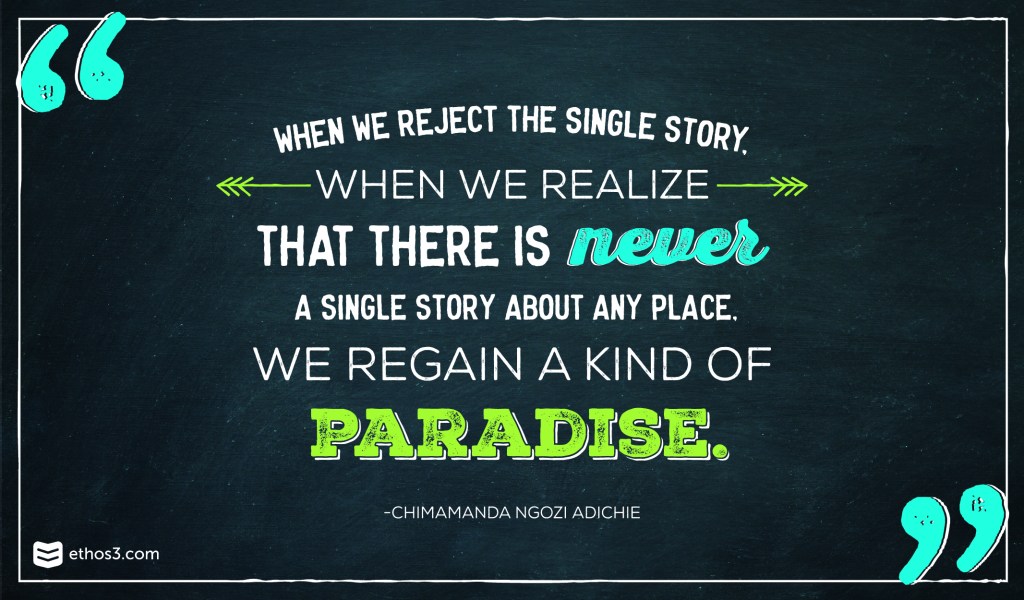
Throughout Chimamanda’s entire TEDtalk she focuses on how dangerous it can be to have a single story of someone. A single story can rob people of their dignity, it can create stereotypes, and it makes us different. Having a single story about someone makes that story the only story about them, which can create a biased view of a person. While watching this TEDtalk I noticed myself thinking back to Alice Walker’s piece, “In Search of Our Mother’s Garden,” and how in this piece she talks about the struggle black women writers face being a woman and being an artist. This made me think of how black women of the past and today have a single story written about them. This single story written about black women writers has kept these women from using their creativity for years. Chimamanda ends her TEDtalk with the positives of have many stories, rather than having just one story, “That when we reject the single story, when we realize that there is never a single story about any place, we regain a kind of paradise.” The ending to Chimamanda’s TEDtalk in a way reminded me of the ending to Alice Walker’s piece, “Guided by my heritage of a love of beauty and respect for strength—in search of my mother’s garden, I found my own.” This reminded me of the ending to the video because it was through looking at others stories and through looking at the creativity of others, that Alice Walker was able to find her own creativity and passion for writing.
Response question: What do you think is the single story that is written about black women as writers?
Response question: Has there ever been a time you felt that you had a single story of someone? Have you ever caught yourself being biased towards someone or something? You don’t have to share if you don’t feel comfortable!