Our group is exploring the concept of “Reading the World,” as inspired by Ann Morgan, a London-based book editor who embarked on a project to read a book from every UN-recognized country. Please watch Anne’s TED talk “My Year Reading a Book From Every Country in the World” and then respond to the following questions in the comments:
-What non-American or non-British books have you read in the past (K-12)? Did you read these books in translation, or were they written in English by an international author?
-Take a look at Ann Morgan’s blog and her reading list: https://ayearofreadingtheworld.com/thelist/. Read at least one of her book reviews. What books from her blog are you most interested in, and why?
Thanks! – From Teodora, Meg, Julie, Sarah, and Lexi
Hi there — it’s not my week to post, but I want to share two videos that I use with my high school students (and once with middle school students actually) about the concept of Orientalism:
And this one is from Al Jazeera:
As an interesting aside, the Al Jazeera one had a little box below reading “Al Jazeera is funded in part or in whole by the Qatari government” while the BBC had no such box even though the BBC is likewise government funded, albeit by the British. Orientalism at work?
I hope this helps with your understanding of Said!
I wanted to blog / facilitate this week because I wanted to dive more into Virginia Woolf, who is one of my favorite historical figures. I was first drawn to Virginia Woolf and her life story in high school when I first experienced depression, but I find her work from the 1920s to be particularly interesting in this current social moment and given the parallels between the 1918 flu epidemic and today’s pandemic. Given the current mental load that we are all experiencing as a result of the pandemic and current events, I traced how some of our authors this week–specifically Virginia Woolf, Keeanga-Yamahtta Taylor, and the women of the Combahee River Collective–explore mental illness in their construction of feminism. In class, I will be leading us through a short history of First Wave feminism and a shared annotation activity.
There is a long and potent history between supposed mental illness and the feminist experience. We can dive into a variety of historical examples–for example, suffragette Alice Paul being institutionalized–and I will be going through some of these examples in class as we explore the history of First Wave feminism and how it relates to Woolf. However, since we are drawing connections between the past and the present–I’d like us to consider a common meme on social media– a list compiled of causes of mental illness in patients admitted to a West Virginia asylum. Regardless of the accuracy of this meme, the number of complaints specific to women (ie “imaginary female trouble, marriage of son”) is a sobering reminder that those who defied gender norms–and in rejecting them, could be called early feminists–were frequently labeled as “mentally ill.” This meme is particularly potent and shared widely to this day–and I think a big reason for that is the propensity for doctors to still dismiss women’s complaints as psychosomatic, an effect that is amplified for women of color.
Comic relief– but really, I’m always amazed at how much memes tell us about how history is portrayed in our own society!
Woolf explores this phenomenon in a different light in A Room of Her Own, explaining that women frequently experience mental distress upon recognizing the conditions of their oppression. In the fable of Shakespeare’s sister, she notes that “any woman born in the sixteenth century certainly would have gone crazy…” (898). What I find most interesting about Woolf’s characterization, however, is her discussion of “genius” and how interplays with class, race, and ability.
In the essay, Woolf notes that genius “is not born today among the working classes”–which seems at first glance to be an incredibly classist statement. However, she validates this statement with the remark that “How could it have been born among women…whose work began… almost before they were out of the nursery?” (897) While this does recognize that ability can be found in individuals of all genders and class backgrounds, this formulation is still limited by the assumption that “genius” is restricted only to skills developed in formal education. She recognizes the potential for genius among women in lower classes, but infantilizes these women, claiming that as a result of their upbringing, they are now incapable of producing great works. Would Woolf have recognized the “genius” of folksongs or handcrafts? Additionally, I am intrigued that, with a rather limited definition of what “genius” actually is, she laments that “any woman born with a great gift in the sixteenth century would have certainly gone crazed” (898). What would Woolf have thought of a woman who, with no “great gift,” still recognized the conditions of her oppression? (Or would that recognition be in itself an indication of a “great gift?”) In Woolf’s formulation, mental unrest in response to oppression is a natural response for those with superior ability.
Woolf’s formulation of mental illness demonstrates both her class background and the experience of white Britons in an age of empire. I’ve always been fascinated by Virginia and Leonard’s relationship and collaboration, so I was interested–but not entirely surprised–to learn that Leonard had begun his career as a colonial administrator. Ever since I read Mrs Dalloway in high school, I’ve also been fascinated with how Woolf addresses immigration–in that text–through the character of Lucrezia, an Italian immigrant married to a World War I veteran suffering from PTSD. Yet, in her short parable, she makes no mention of race or immigration–which is not surprising. Like many other white female feminists of her time, Woolf’s life and actions were incredibly radical, yet also worked within the traditional system and centered the experiences of upper-class, white females in the Western world.
In contrast, the Combahee Women’s Collective directly addressed both issues of empire and issues of mental health–for ALL women, not just the “mad,” gifted few. As Taylor notes in her introduction, the CRC had an internationalist focus, making this important distinction to demonstrate “solidarity with women in countries that were often suffering because of the policies and military actions of the US government” (12). While this might seem radically ahead of Virginia Woolf’s time, it is important to note, as Taylor does, that in the early 1920s (the same time that Woolf was selling A Room of Her Own to the wealthy, well-read white women of the British Empire), Lenin was identifying and recognizing the levels of oppression that minorities faced in addition to the class struggle (as a side note: this is something that I don’t know a lot about, but I’m interested in learning more about!)
The connections between the CRC statement and mental illness are less obvious than in A Room of Her Own, but are nevertheless potent. As Taylor notes, the CRC itself and Black feminists, in general, rallied around causes of reproductive justice, especially ending the forced sterilization programs that were rampant in the 1970s (I’m going to pause here to let that fact sink in for anyone who was unfamiliar with this–when I learned about these programs as an undergrad, it blew my mind that women of color were being sterilized against their knowledge in my mother’s lifetime and I was horrified that we had never talked about this in school). However, these sterilization programs began in the early 20th century as a way of reducing mental illness (classified as “feeblemindedness”) in women–both of color and white–who were institutionalized. As the infamous Supreme Court case of Buck vs Bell shows, women who were working class, mentally ill, and considered “promiscuous” (but were often the victims of rape or sexual assault!) were more likely to be targetted for sterilization early on. In fact, the very experiences of women who were targetted by sterilization schemes demonstrate the interplay of class, sexuality, gender, and ability. However, by the 1970s, these efforts had been more secretive and more targetted on women of color–a move that also corresponded with changes in healthcare for the mentally ill and deinstitutionalization.
In addition to focusing their activism in reducing sterilization–a form of oppression that started with deadly misguided ideas of how to care for the mentally ill–the women of CRC also directly address the relationship between mental illness and the experience of living in a patriarchal, racist world. Early on in their statement, the women explain: “Black feminists often talk about their feelings of craziness before becoming conscious of the concepts of sexual politics, patriarchial rule, and, most importantly, feminism” (Taylor 17). In this statement, they draw a direct line between the feelings that Shakespeare’s theoretical sister faced and the experiences of Black women in the 1970s. However, unlike Woolf–who links this sense of perceived madness with only the talented–the women of the CRC generalize this feeling to all of their Black and brown sisters, attesting that the systems “did not allow most Black women” to critically examine *why* they felt so-called “crazy”. Furthermore, unlike Woolf (in the section that we looked at), the women of the CRC offer a simple solution: giving Black women a lens to understand how the system has let them down and how it connects to their mental health.
As we look at these two texts in conversation with another, they bring to mind a few questions to situation our discussion in a broader historical and political context:
Discussion Questions:
-What is the relationship between early 20th century feminism and experiences of empire? How do we see experiences of empire and neocolonialism impacting discussions of race, class, and gender today?
-Many of the most oppressive body politics in the 20th century–the eugenics movement, forced sterilization, and even the Holocaust itself–started out targetting those with mental illness or so-called “inferior” mental abilities. What is the relationship between race, class, gender, and ability studies / politics?
-The women of the Combahee River Collective were engaged in issues of reproductive justice and worked at the intersection of queer and feminist politics. Where do we see these intersections and engagement with reproductive justice today?
Lexi’s Personal Question:Would anybody like to dive into excerpts of Mrs Dalloway or other Virginia Woolf texts for the student-facilitated lesson later in the course? Given the circumstances, I’m especially interested in how the 1918 Spanish flu pandemic influenced Virginia Woolf’s life and how it is discussed in texts such as Mrs Dalloway. Also bonus points for anyone who has read The Hours by Michael Cummingham or seen the film =)
Hi there! My name is Lexi Hartley and I am starting the MA program in English at Cortland part-time this fall. In my full-time life, I am a certified Secondary Social Studies teacher and I work as a Humanities Teacher at the Lehman Alternative Community School in Ithaca. I have lived upstate for four years; before that, I taught English internationally in Sarajevo, Bosnia-Herzegovina and studied History, ESOL and Social Studies Education at the College of William and Mary in Williamsburg, VA. I have the great privilege of teaching at a school where all our classes are thematic, so my classes vary, but my favorite classes and topics to teach are Black history and literature, Holocaust and genocide history / literature, and Middle Eastern politics and literature. This year, I’m doing more middle school classes than I usually teach, so I’m both quite excited to reconnect with my students and also very excited to be with adults discussing literature and theory at least once a week. It feels a little weird to be back in school as I think I’d count as a “mature student” at this point, but since I teach interdisciplinary English classes at my school, I’m hoping to get NYS Certified in teaching English as well as Social Studies and more importantly, build my content knowledge to be a better teacher for all my students! I was excited to take this class online both for the obvious pandemic reasons but also to explore new methods of online learning, as I enjoyed teaching online in the spring more than I thought I would.
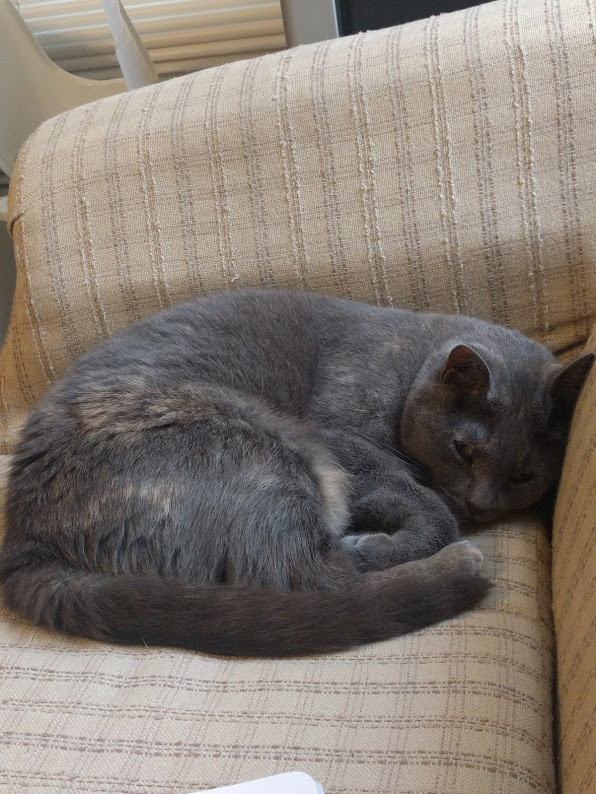
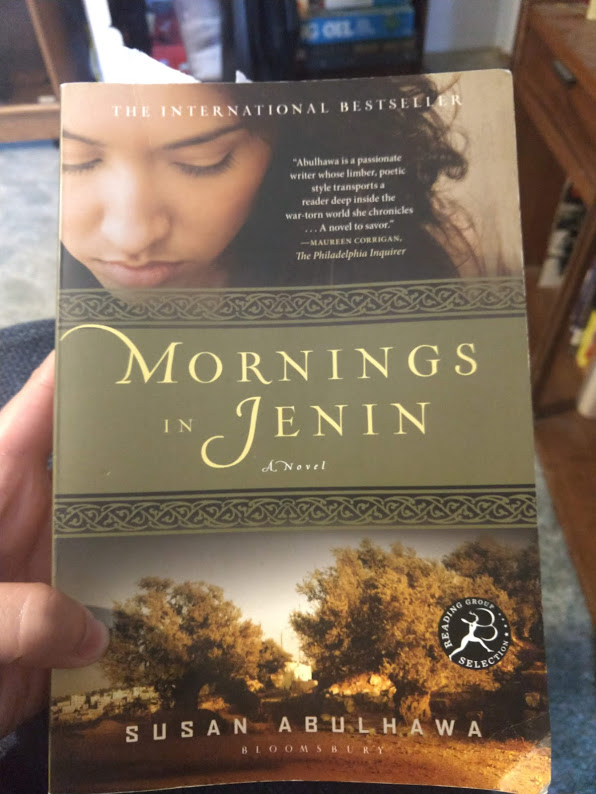
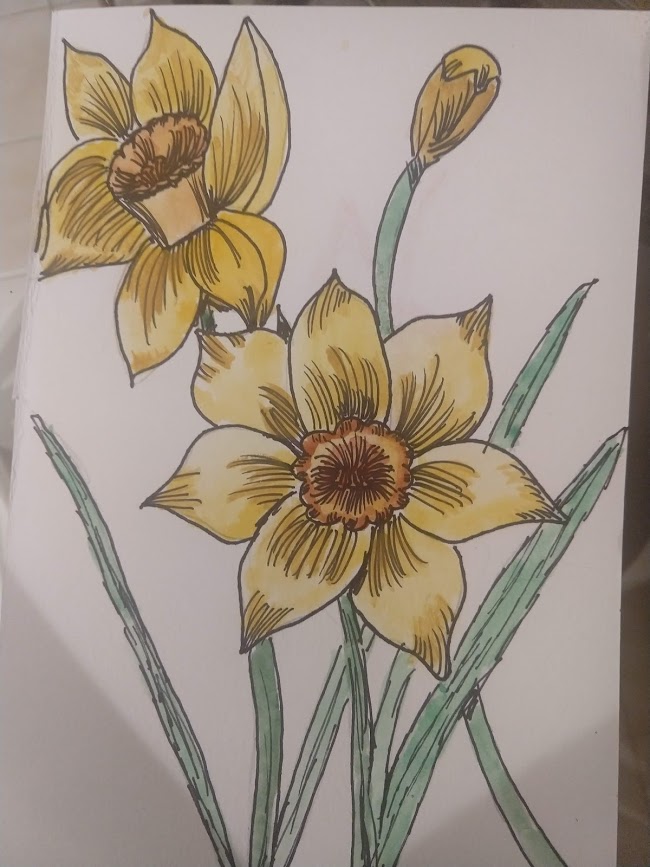
I’m glad that Danica posted an image of her cat, so I can share pictures of Nog, our very fluffy and majestic diva / cat! You all will probably meet Nog soon as she likes trying to swat at my computer and camera when I’m in an online class (it’s basically the only time when she’s not hungry that she acknowledges my existence). When I’m not being ignored by Nog, I enjoy hiking with my spouse and watercolor painting, which a hobby that I started rather recently. I’ve shared an image of one of my paintings. Before this summer, the last time I did art was probably in an art class in middle school, but I’m finding it’s really liberating to be an absolute beginner and completely untalented at something–it makes any progress really gratifying and gives me a good sense of how my students might feel. I’ve also been trying to read a lot more fiction this summer than usual, so I’ve posted an image of Mornings in Jenin, my favorite book that I read this summer, which was written by Palestinian-American author Susan Abulhawa.
In terms of this class, two topics that I would like to learn a little more about:
As a white, straight, cisgender female educator teaching in a primarily white institution, what resources can I use to meaningfully engage my middle and high-school aged students in topics of race, class, and gender?
As a reader, I am naturally drawn to fiction more than nonfiction, which is something that I find that I share with my students. I’m curious about how to connect the topics that we will be discussing in class with fiction, especially fiction that I have taught or might be teaching. Finally, how do we connect our emotions and epxeriences whilst reading fiction about the “before times” while we are living in COVID times?
Now of course, what everyone has been waiting for– cat photos!
My cat, Nog. She looks sweet here, but she has her eye on you. Favorite summer read, although a super depressing book to read in current times and crises. Also, it’s totally normal to take pictures of books as soon as you finish reading them, right? I’m way too proud of myself for this.